
Driverless or Autonomous cars are the future of transportation and the future is closer than you may think. It may take a couple more years to perfect the technology but few people doubt that autonomous cars will be a reality in the near future.
A driverless car is capable of sensing its environment and navigating without human input. They achieve this with the help of radar, lidar, GPS and computer vision. Advanced control systems interpret sensory information to identify appropriate navigation paths, as well as obstacles and relevant signs.
Geneva Motor Show
Most autonomous cars are rough, experimental versions of current models, with all sorts of added sensor hardware. However, the recent Geneva Motor Show has showcased several futuristic design studies that took a look into the car cabin of the future.
The Swiss automotive think tank Rinspeed has offered one possible version of the future in autonomous vehicles with its Xchange concept car, which premiered at Geneva.
“I wanted to put the passenger at the center of what is possible, not the autonomous driving technology,” says Rinspeed’s founder and chief executive Frank Rinderknecht. “Travelling in a driverless car will no longer require me to stare at the road, but will let me spend my time in a more meaningful way.”
“The question then arises, would I like to work, to sleep, to read, to do whatever activities you might do on a train, or a plane? I wanted to start thinking about how autonomous cars would ‘move’ people, and not just in the literal sense,” Rinderknecht said.
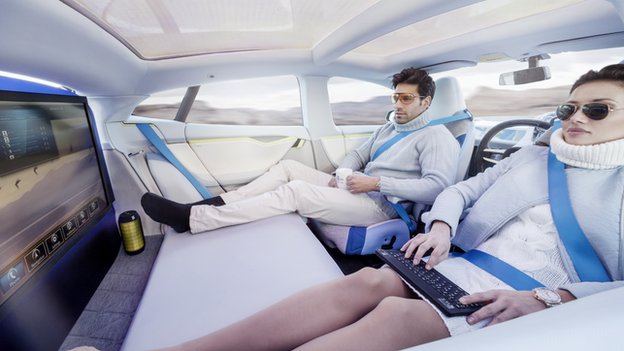
Rinspeed has taken a four-seater saloon and reconfigured the interior into something that would not look out of place inside a small private jet, except its actually in a standard-sized electric Tesla Model S.
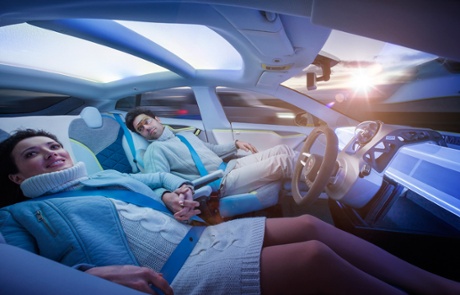
“It would have been easier in a van or stretch limousine, obviously,” said Rinderknecht. The seats were made to swivel, tilt and slide into 20 different positions, enabling passengers in the front to turn and face those in the back or lie back and watch a 32-inch screen.
Enjoy the Ride
The steering column can be moved to the center of the vehicle for better access to an information and entertainment system running the full length of the dashboard. The system features two pivoting LCD displays to surf the web, check emails or even video conference. Everything is fully connected to the world in real-time information and cloud services.
Even though the Xchange is experimental, Rinspeed has worked with established sub-contractors to prove that the concept is feasible.
Rinderknecht says that driverless cars will not mean the complete end of driving altogether, there will be times when people will want to drive.
“Most driving is boring because you are just eating miles and miles. If I go on the motorway from London to Birmingham, it’s not very joyful. However, if I go over an Alpine pass, I want to drive myself, I don’t want the machine to do it.”
Rinspeed is used to pushing automotive design to the limits. What Rinderknecht calls his “crazy Swiss team” is behind several extreme projects, including it Squba underwater car.
“We are a small company and can think outside the box. We don’t have all the big companies’ constraints, processes and politics. We can be a lot more agile.”
Rinderknecht says he chose the Tesla in part because electric and hybrid vehicles are the future, but also because the configuration of the car was best suited for the multi-position seats.
“People won’t want standard seats in autonomous cars. Have you ever tried to sit back in your car? Your shirt rides out of your trousers. We had to redesign the whole seating schematics.”

Relax and Leave the Driving to the Car
Overcoming safety, liability and regulatory issues will be a big challenge for manufacturers of autonomous cars. Rules governing seat safety are among the most complex, especially when designers want to have them flat, but few of us give it much thought.
“Our starting point was the business cabin of an aircraft and we went from there,” Rinderknecht says. And then there is the issue of comfort. “All that braking and going over bumps, you need a seat that will let you relax,” he says. Rinspeed developed the seats with the world-renowned manufacturer of medical prosthetics, Otto Bock Mobility.
“There will come a time when we will be travelling in a container, with no airbags or seatbelts because the chances of an accident will be so small.” He sees a convergence of automotive technology and artificial intelligence as “an enabler of a new industrial revolution”.

 Michael D. Turashoff
Still a lot to work on this technology.And I firmly believe,this tech would reshape the mankind, not only in the automotive sector but in all aspects.
LikeLike
Thank you very much for responding. I’m curious why do you think this technology is so important and do you really think we need it? Would we be better off with it or would we be just fine or better off without it?
I’m not saying you are wrong I’m just wondering myself. I’m mot so sure we need this technology or if we’d be better off without it.
I look forward to your thoughts and anyone else who wants to join in.
LikeLiked by 1 person
I appreciate your thoughts. In some areas, we do need this and in some areas we don’t. Basically, it depends on our requirements. Some of us do need it and some of us don’t. Actually, I’m still working on it. I’ll update you. Thanks.
LikeLike
Paul,
I’m interested in your opinion. What do you think would be the main benefits to this technology?
LikeLiked by 1 person
In this reply box, I would say,”It’s gonna push the human race forward.”Don’t limit your thinking to this planet. What if AVs will probe other planets where suitable energy resources are available? Thanks for showing concern.
LikeLike
Very cool thinking Paul! No, I thank you for your interest in my blog and for sharing some interesting thoughts with us. Please come back again and share some more of your thoughts with us. Have a great day, and take care of you!
LikeLiked by 1 person
Thank you sir. Take care. Health comes first then work. Good day.
LikeLike
Same to you my friend I hope to hear from you again.
LikeLiked by 1 person